Evolving's evolution
Reflections on becoming an artist through making and showing my first work

Nearly 30 years ago, exploring the Art Institute of Chicago, I had an experience that has stayed with me ever since. Among the ancient ceramics displayed in the Asian Art gallery, an opening in the wall framed a view of Andy Warhol's enormous painting of Mao, hanging in the distance down a hall in another gallery. I loved the surprise of it, the curator's choice to juxtapose ancient and modern through this composed, framed view. While I have found just a single text description of this curatorial Easter egg online, I’ve never been able to find an image; the work is not displayed that way today. Later, in a landscape architecture class, I learned about the use of changing and framed views in classical Chinese garden design. It’s something I’ve thought about a lot and look for now wherever I go.


For years, this idea stayed with me as something I loved but had no practice to pursue. That changed last month when I had the thrill of seeing it become a lived, three-dimensional experience. My multi-part, ceiling-suspended piece, Evolving, hung in the Tampa Bay Surface Design Guild’s gorgeous show, Living in Color, at the Werk Gallery in St. Petersburg for the month of May. It was my first time taking something I'd been carrying in my head, building it with my hands, and getting to see it work; visitors were moving around the piece and discovering the changing framed views I'd been imagining. While I have gone on to make and show more work since I first completed this piece, Evolving is special to me because it embodies my growth from art enthusiast to artist. With the closing of the show, I’ve been reflecting on this transition, and what an adventure the making of this piece was.


Getting started
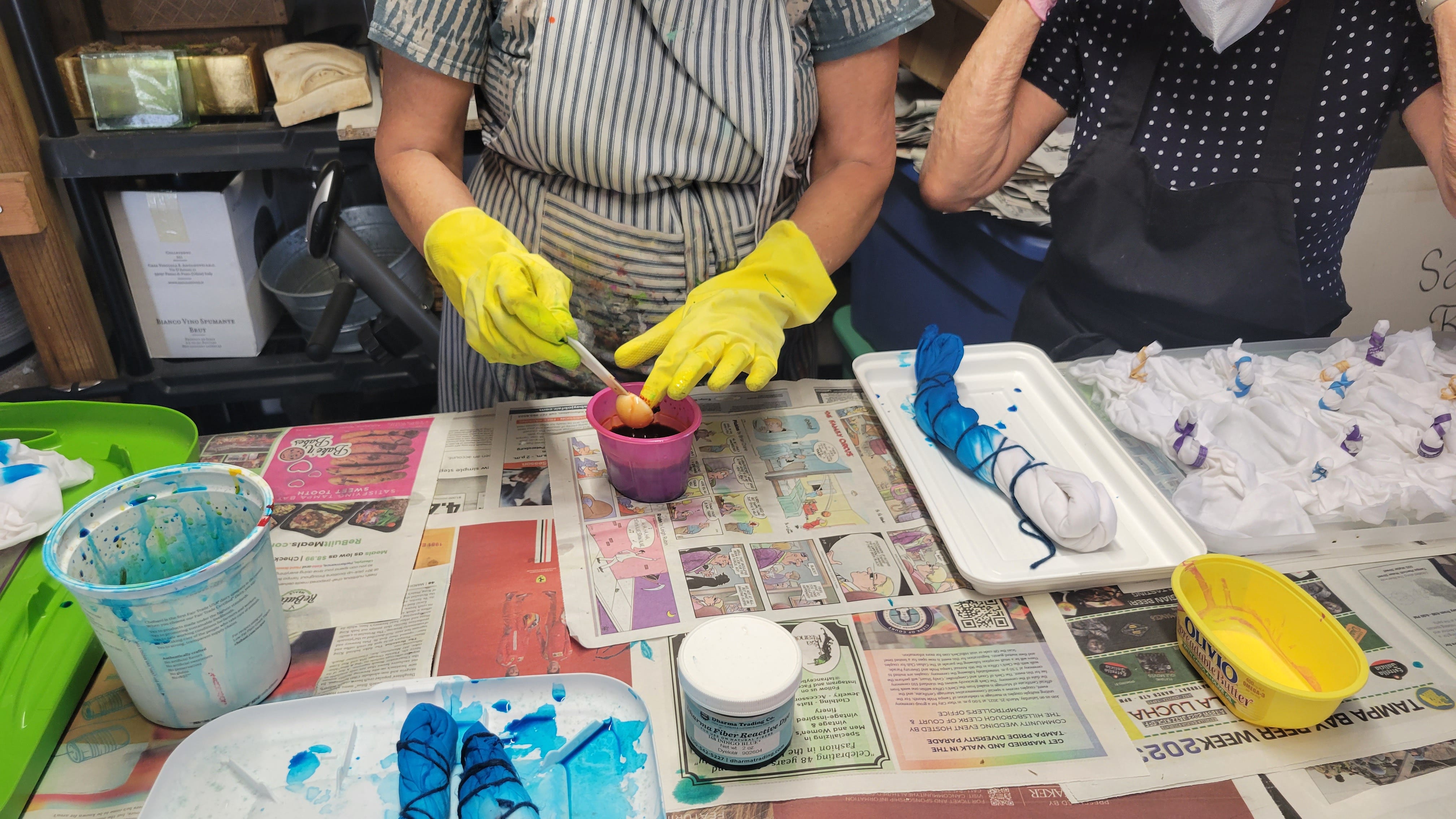
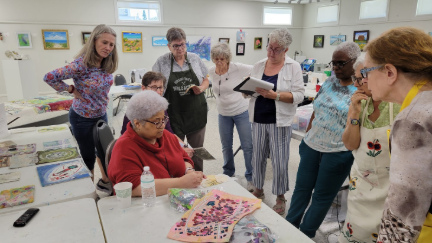
Since that first experience at the Art Institute of Chicago, I’ve continued to visit galleries and museums and generally enthuse about art, textiles, and great landscape architecture, but without an art practice of my own. That changed in 2022, when I had the good luck to chat with local artists Elizabeth Neily and Katie Deits at Florida CraftArt. They encouraged me to join the Tampa Bay Surface Design Guild, an incredibly collaborative, supportive and creative community of artists and mentors. In 2023, when the guild started planning a show celebrating the Florida Botanical Gardens, they got right to work holding workshops on the fundamentals of fabric dyeing and surface design, encouraging members to create large work to fill the gallery spaces. Looking back, this was such a momentous time for me – learning not only the techniques, but how to play and experiment, share my work with others, and build confidence with the support of these inspiring mentors. Suddenly in a community where it is not uncommon to have a home studio, I found myself converting a small space of my own to work in.
I explored the gardens looking for inspiration for my piece and during this visit got to see Yolanda Sanchez’s colorful fabric panels at The Gallery at Creative Pinellas. The combined experience made me realize my opportunity to re-create the changing framed views in a garden through an experience created in fabric. I started imagining paired panels forming gates that could be looked through to see other works in the gallery.


Also in 2023, the guild offered a workshop on making art quilt maps with architect and artist Valerie Goodwin. I am so fortunate to have studied with Valerie when I did. Her workshop helped me learn to play with materials through a spatial analysis workflow that I’m very familiar with in my paid work as a GIS analyst. I think this framework helped build my comfort in creating and building an artistic practice. It also inspired another level of thinking about the garden-inspired piece. Together, the panels could form a map of the garden.
Making the work
Working on the creation of this piece through mapping analysis, research and documentation and the material questions of how the work hangs was such a helpful way to enter into thinking about making work. I explored, photographed, and researched the gardens, learning more about the various species found in each garden space. I analyzed the landscape design and flow from one garden to the next, thinking through how this could translate into the panel configuration. I worked on building a visual language for the piece by translating my images into simple shapes and icons and then into stencils and stamps. I experimented and swatched with fabrics and dyes, eventually settling on a gradient from yellow to blue as something both appropriate for the subject and achievable at my skill level.


I started with building a series of small paper models before moving to full-size work. Working out the positions and heights of the pieces to create views through the work from end to end while maintaining a single perspective from the side of the map as a whole was an interesting challenge. In my studio, it involved a system of hanging rails my husband Jeff helped me build to allow me to easily shift the work around.


Showing the work
In the gallery setting, hanging the work is a little more challenging! In the summer 2024 guild show at the Gallery at Creative Pinellas, my effort to prepare a paper template was stymied by the very tall and steeply sloped ceiling of the gallery space. Curator Freddie Hughes wrestled with that hanging, but got it done, which I so appreciated. In that show, the work hung above our heads, so it was lovely to see my work as part of the show but it did not create the experience for the visitor that I had originally imagined.


I realized I had another chance at presenting the work when I entered it in the guild’s show this May at the Werk Gallery. I prepared careful documentation explaining the intent of the piece, including diagrams and measurements. I went to the gallery in person to drop off the work and got to speak with owners Fritz and Matthew Faulhaber in person, and then curator Nathan Beard over the phone. I’m so appreciative of the work they put into hanging the piece. I was totally delighted when I arrived the night of the opening and got to see people experiencing the changing framed views the way I had imagined.
A personal note on the title: I named Evolving in recognition of the gym where I finally fully recovered from a back injury and nerve pain through strength training with coaches including John Hall. That work made it possible for me to do full days in a studio without being limited, which is such a gift. This work embodies a lot of gifts. I incorporated in it all of the techniques that my wonderful teachers and mentors at the Tampa Bay Surface Design Guild have been teaching me, including fabric dyeing, silk screening, linocut printing, discharge, quilting, weaving, and most importantly, how to take myself seriously as an artist and member of an incredible arts community.
What’s next
I plan to continue working in this series, exploring how I can create shifting views through fiber and mixed media, and capitalizing on the library of materials, images and tools I have created to develop this piece. As part of that work, I created a small three-dimensional standing piece incorporating wooden hoops and suspended mobile elements. My main critique of Evolving is that it is much smaller in person than it had become in my mind and it looks on Instagram! I may work on another iteration and this time try working much larger.
These ideas have also spawned subsequent bodies of work: dimensional weavings on frames that can be explored from multiple angles, and a redlining series that layers spatial analysis with art quilting and book arts to explore the history of discrimination in US housing policy.


When I started this work, I was not comfortable calling myself an artist. My artist statement in 2024 called me a beginner, learning to work with materials. While it irritated a few of my guild colleagues, who insisted we are all artists, I thought it was honest. Having completed and shown Evolving, I am more comfortable with the word artist, in part because I now have the experience of imagining something and then creating it to share with others. But also because I’ve learned through this work, my membership in the guild and the encouragement of others that, as my guild colleagues insisted, we are all artists and we all have so much potential. We should worry less about what we call ourselves and get busy making more art.
Working in textiles, fiber, mixed media, and book arts, I make three-dimensional work that asks viewers to look through, beneath, and between surfaces. See more at https://katebird.art and follow me on Instagram at @katebirdfiberart.